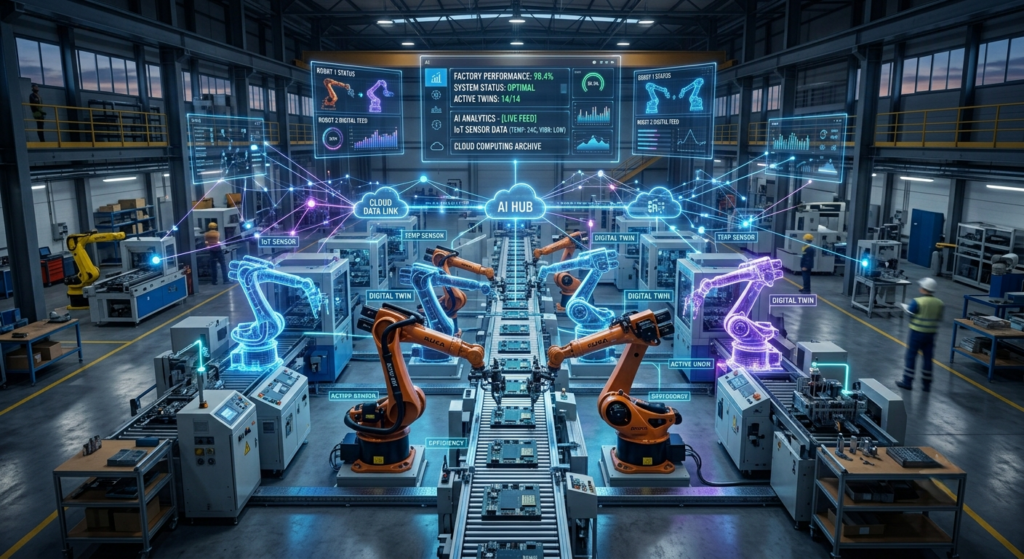
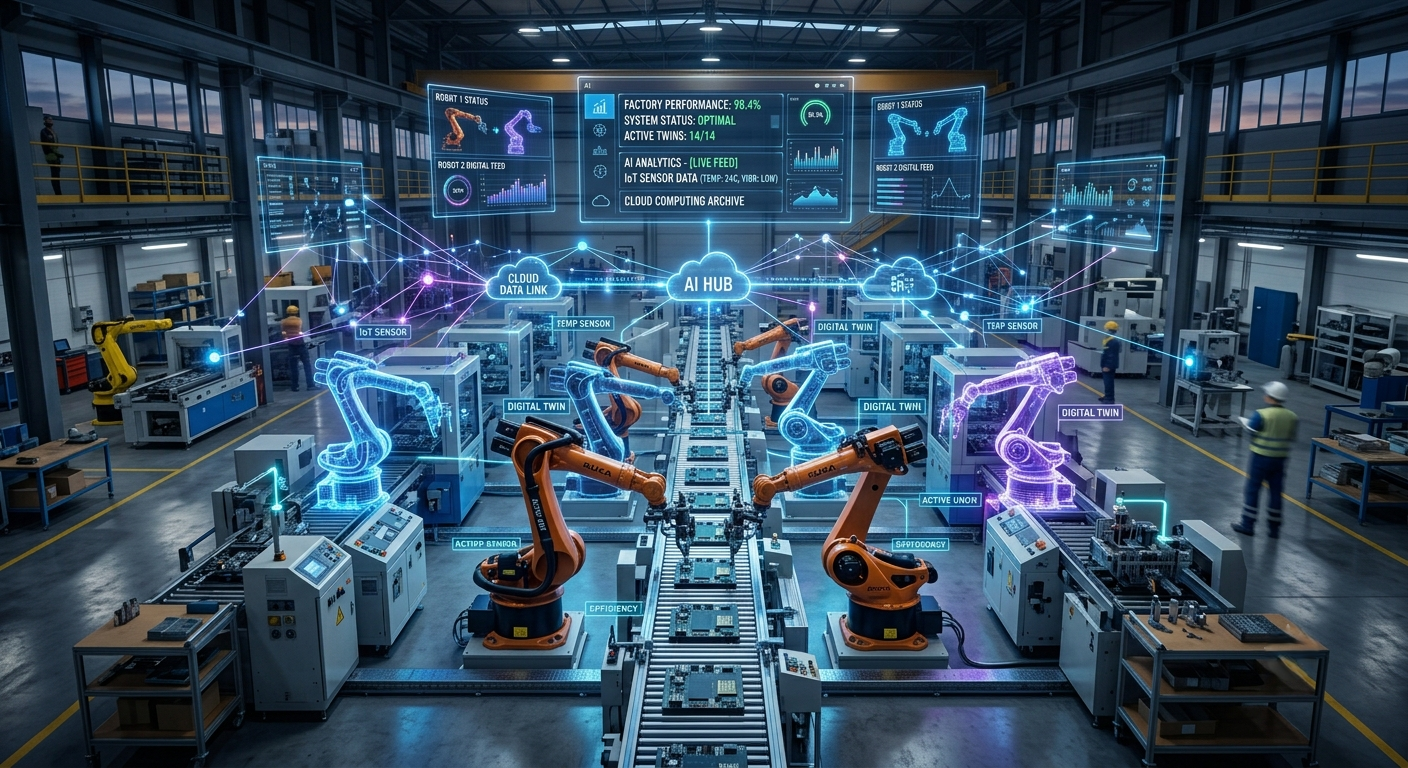
Digital Twins improving manufacturing through AI-powered virtual simulations
Digital twin technology enables companies to simulate, monitor, and optimize physical systems in real time.

Digital Twins: 8 Amazing Innovations Transforming Modern Industry

Modern industries are becoming increasingly connected through artificial intelligence, cloud computing, and the Internet of Things (IoT). One of the most exciting technologies driving this transformation is Digital Twins. Rather than relying solely on physical testing, organizations can now create virtual replicas of machines, buildings, factories, and even entire cities.

These digital replicas continuously receive real-time information from sensors installed on physical assets. This allows engineers, operators, and decision-makers to monitor performance, predict failures, and test improvements without interrupting real-world operations.

As businesses continue investing in automation and data-driven decision-making, Digital Twins are becoming an essential tool for improving efficiency, reducing costs, and supporting innovation across multiple industries.

In this article, we’ll explore eight amazing ways this technology is transforming modern industry and why it is expected to play a major role in the future of digital transformation.


Why Digital Twins Matter

Traditional computer models often represent only a single point in time.

Digital twin technology goes much further by continuously synchronizing virtual models with their real-world counterparts.

This enables organizations to:

  • monitor equipment in real time
  • improve operational efficiency
  • predict maintenance needs
  • optimize production
  • reduce operational costs
  • test improvements before implementation

Instead of making decisions based solely on historical information, businesses can use live data to improve performance every day.


1. Smarter Manufacturing

Manufacturing is one of the largest adopters of Digital Twins.

Factories can create virtual replicas of entire production lines to monitor equipment, identify bottlenecks, and improve efficiency.

Benefits include:

  • production optimization
  • quality control
  • workflow improvements
  • reduced downtime
  • energy efficiency
  • better resource planning

Instead of stopping production for testing, engineers can evaluate improvements inside virtual environments before applying them to real equipment.

This reduces risk while increasing productivity.

🔗 Official Resource: https://www.siemens.com


2. Predictive Maintenance

Unexpected equipment failures are expensive and often disrupt business operations.

By combining IoT sensors with virtual simulations, organizations can detect early signs of wear before machines fail.

Examples include monitoring:

  • vibration
  • temperature
  • pressure
  • energy consumption
  • operating speed
  • mechanical stress

Rather than following fixed maintenance schedules, companies can service equipment only when necessary, reducing costs and extending equipment lifespan.

Predictive maintenance has become one of the most valuable applications of digital twin technology.


3. Smart Cities

Cities are becoming increasingly connected through sensors and intelligent infrastructure.

Virtual city models allow planners to simulate:

  • traffic flow
  • public transportation
  • emergency response
  • energy usage
  • water distribution
  • environmental conditions

Instead of reacting to problems after they occur, city planners can test different solutions virtually before making real-world changes.

This helps improve public services while reducing operational expenses.

Read Also: 6G Networks: 8 Revolutionary Innovations That Will Transform Global Connectivity


4. Healthcare Innovation

Healthcare organizations are beginning to use Digital Twins in exciting new ways.

Researchers are developing digital models that can simulate:

  • medical devices
  • hospital operations
  • patient treatment plans
  • surgical procedures
  • healthcare workflows
  • biological systems

These virtual environments allow professionals to evaluate different scenarios before making important clinical decisions.

Although still evolving, this technology has the potential to improve patient outcomes while reducing costs and increasing efficiency.
5. Aerospace and Aviation

The aerospace industry depends on precision, safety, and continuous monitoring. Digital Twins help engineers create virtual replicas of aircraft, spacecraft, and critical components, allowing them to evaluate performance throughout their entire lifecycle.

Applications include:

  • aircraft engine monitoring
  • structural integrity analysis
  • flight performance optimization
  • satellite health monitoring
  • spacecraft testing
  • maintenance planning

Instead of relying solely on physical inspections, engineers can simulate different operating conditions and identify potential issues before they affect real equipment.

This approach improves reliability while reducing maintenance costs and minimizing unexpected downtime.

🔗 Official Resource: https://www.nasa.gov


6. Energy and Utility Management

Energy providers are increasingly using virtual simulations to improve the efficiency of power generation and distribution.

These systems help operators monitor:

  • power plants
  • wind farms
  • solar farms
  • electrical grids
  • battery storage systems
  • transmission networks

By analyzing real-time data, operators can identify inefficiencies, forecast equipment failures, and optimize energy production.

As renewable energy continues expanding worldwide, digital twin technology is expected to play an increasingly important role in balancing electricity supply and demand.


7. Construction and Smart Buildings

Modern construction projects are becoming more data-driven through intelligent digital models.

Engineers and architects can use virtual replicas to:

  • monitor structural health
  • improve building efficiency
  • optimize heating and cooling systems
  • manage maintenance schedules
  • analyze energy consumption
  • enhance occupant safety

Building owners can also monitor performance after construction is complete, helping reduce operating costs throughout a property’s lifetime.

By combining sensors with real-time analytics, digital models support smarter building management and more sustainable urban development.


8. Artificial Intelligence Enhances Digital Twins

Artificial intelligence is making Digital Twins even more powerful by enabling predictive analysis and automated decision-making.

AI can help digital models:

  • detect equipment anomalies
  • predict maintenance requirements
  • optimize production schedules
  • improve product quality
  • simulate future scenarios
  • recommend operational improvements

Instead of simply displaying information, intelligent systems can provide actionable insights that support faster and more informed decisions.

As AI capabilities continue advancing, virtual simulations are expected to become increasingly accurate and valuable across multiple industries.

🔗 Official Resource: https://developer.nvidia.com/omniverse


Challenges and Future Considerations

Although the benefits are significant, implementing digital twin technology also presents several challenges.

High Initial Investment

Creating accurate digital models often requires advanced sensors, cloud infrastructure, and specialized software, resulting in considerable upfront costs.

Data Quality

Digital models are only as reliable as the information they receive. Inaccurate or incomplete sensor data can reduce simulation accuracy and lead to poor decision-making.

Cybersecurity

Because virtual models often connect to critical infrastructure, protecting operational data from cyber threats is essential.

System Integration

Many organizations still operate older equipment that was not designed for modern digital connectivity. Integrating these legacy systems can be complex and time-consuming.

Successfully addressing these challenges will be key to wider adoption across industries.


The Future of Digital Twins

As artificial intelligence, IoT, cloud computing, and advanced communication networks continue evolving, Digital Twins are expected to become even more sophisticated.

Future developments may include:

  • AI-powered autonomous optimization
  • real-time global industrial monitoring
  • fully connected smart factories
  • intelligent healthcare simulations
  • autonomous transportation management
  • climate and environmental modeling
  • digital infrastructure planning
  • advanced robotics integration

The combination of real-time data and predictive analytics has the potential to transform how businesses design, operate, and maintain complex systems.

Read Also:AI Agents: 8 Powerful Ways Artificial Intelligence Is Transforming Everyday Life

Read Also:6G Networks: 8 Revolutionary Innovations That Will Transform Global Connectivity


Final Thoughts

Digital Twins are rapidly becoming one of the most valuable technologies driving digital transformation. By creating virtual replicas of physical assets and continuously synchronizing them with real-world data, organizations can improve efficiency, reduce costs, and make better-informed decisions.

From manufacturing and healthcare to aerospace, construction, and energy management, this technology is helping industries operate more intelligently while supporting innovation and sustainability. As artificial intelligence and connected devices continue advancing, digital twin technology is likely to become a standard component of modern industrial operations.

Businesses that adopt these intelligent simulation tools today may gain a significant competitive advantage as industries become increasingly connected, automated, and data-driven.

Disclaimer: This article is for informational and educational purposes only. The technologies discussed continue to evolve, and adoption rates may vary across industries and regions. Organizations should evaluate their specific operational needs before implementing digital twin solutions.