
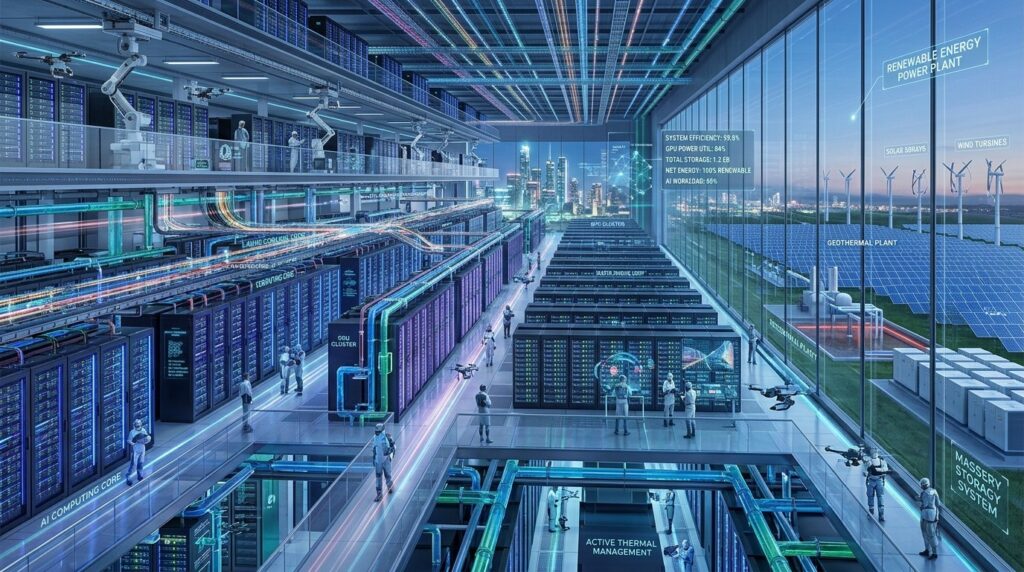
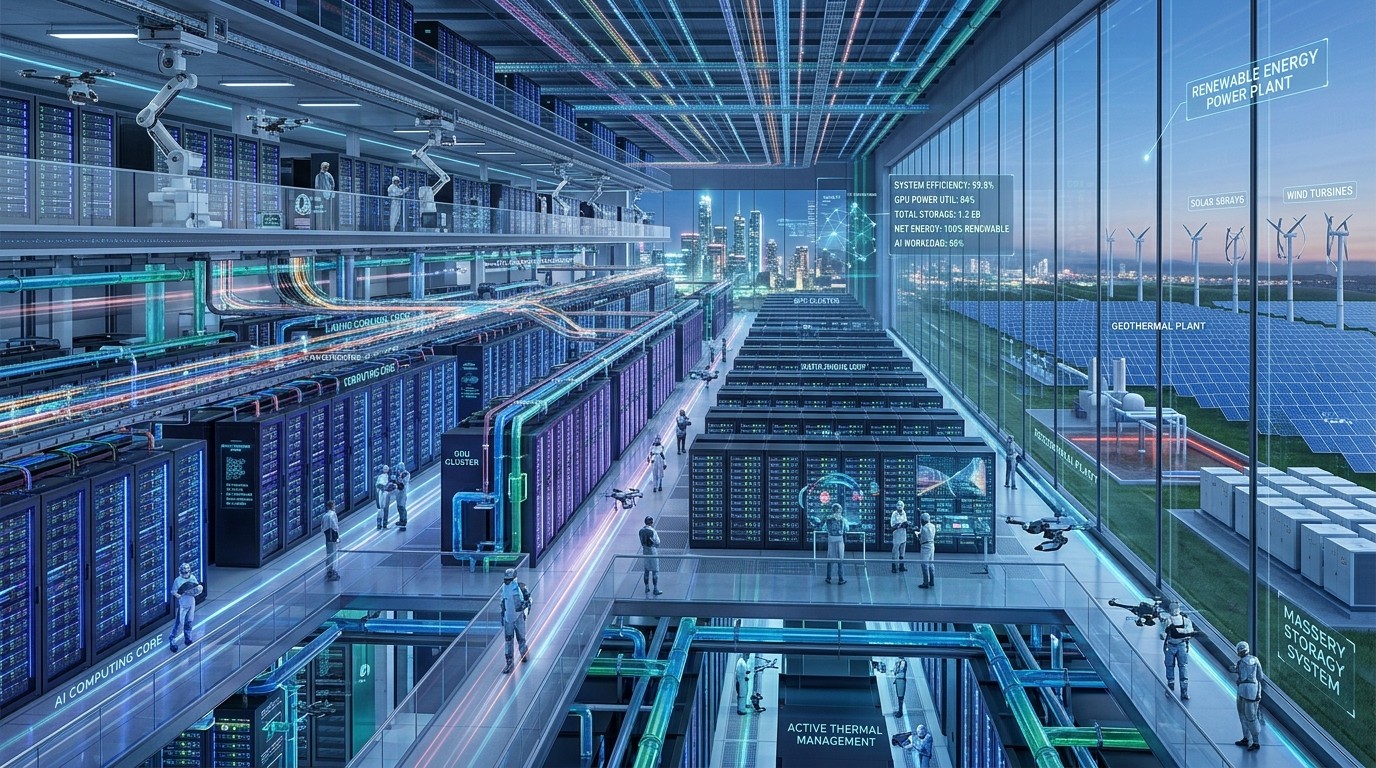
AI Data Centers powering artificial intelligence with GPUs and advanced cooling
AI Data Centers combine massive computing power, advanced networking, and efficient cooling to support modern artificial intelligence.

AI Data Centers: 9 Powerful Technologies Fueling the Artificial Intelligence Boom

Artificial intelligence may appear to exist entirely inside software, but behind every advanced AI model is an enormous amount of physical infrastructure. Powerful processors, networking equipment, storage systems, cooling technology, and electricity all work together to train and operate today’s increasingly sophisticated AI systems.

This infrastructure is creating a new generation of AI Data Centers specifically designed for extremely demanding artificial intelligence workloads.

Traditional facilities were primarily built to host websites, databases, cloud applications, and enterprise software. Modern AI facilities face a different challenge. Thousands of processors may need to work together simultaneously while exchanging enormous amounts of information at extremely high speeds.

Training large AI models can require massive computing clusters operating continuously for weeks or months. Once models are deployed, millions of users may generate additional inference workloads every day.

As a result, companies are redesigning almost every part of the modern data center.

From GPUs and high-speed optical networking to liquid cooling and new power infrastructure, here are nine powerful technologies driving the rapid expansion of AI computing.

What Makes an AI Data Center Different?

A conventional data center typically contains servers running many independent workloads.

Artificial intelligence changes this model because large training jobs often require thousands of accelerators to operate as one coordinated computing system.

Modern AI Data Centers therefore prioritize:

  • extremely high computing density
  • GPU and accelerator clusters
  • low-latency networking
  • massive memory bandwidth
  • high-performance storage
  • advanced cooling
  • reliable power delivery
  • intelligent infrastructure management

The result increasingly resembles a giant computing machine rather than simply a building filled with independent servers.

1. Massive GPU Computing Clusters

Graphics processing units have become one of the foundations of modern artificial intelligence.

GPUs were originally developed primarily for graphics processing, but their ability to perform huge numbers of mathematical operations in parallel makes them particularly suitable for machine learning.

Large AI clusters can connect enormous numbers of accelerators so they work together on a single model.

These systems are used for:

  • large language models
  • generative AI
  • scientific simulations
  • image generation
  • autonomous systems
  • robotics
  • pharmaceutical research
  • weather and climate modeling

The challenge is no longer simply installing faster processors. Thousands of GPUs must exchange information quickly enough that communication does not become the limiting factor.

This has transformed server design, networking, cooling, and even the buildings that contain the hardware.

🔗 Official Resource: NVIDIA Data Center

2. AI Accelerators Are Expanding Beyond Traditional GPUs

GPUs dominate much of today’s AI infrastructure, but they are not the only processors designed for artificial intelligence.

Technology companies are developing specialized accelerators optimized for particular AI workloads.

Examples include:

  • Google’s Tensor Processing Units
  • AMD Instinct accelerators
  • custom cloud AI processors
  • specialized inference chips
  • neural processing architectures

Google’s TPU infrastructure, for example, is specifically designed to accelerate machine-learning workloads within Google’s cloud and AI ecosystem.

Specialized hardware can improve performance per watt and allow companies to optimize infrastructure around particular types of AI workloads.

The future may therefore involve a mixture of CPUs, GPUs, TPUs, and other accelerators working together rather than one processor architecture controlling the entire market.

🔗 Official Resource: Google Cloud TPUs

3. High-Speed Networking Connects Thousands of AI Processors

Having thousands of powerful processors is useful only if they can communicate quickly.

During AI training, accelerators continuously exchange model parameters and other information. Slow network connections can leave expensive processors waiting for data instead of performing calculations.

Modern AI infrastructure therefore relies on extremely high-speed networking technologies.

These can include:

  • high-bandwidth Ethernet
  • InfiniBand
  • optical interconnects
  • specialized AI networking
  • advanced network switches
  • low-latency fabrics

As AI clusters grow, networking becomes almost as important as the processors themselves.

Future systems containing tens or hundreds of thousands of accelerators will require enormous bandwidth to operate efficiently.

This is also one reason photonic and optical technologies are receiving increasing attention. Moving information with light can help overcome some of the bandwidth and energy limitations associated with conventional electrical connections.

Read Also: Cloud Technologies: The Backbone of the Digital Economy

4. Liquid Cooling Is Becoming Essential

One of the biggest challenges facing AI Data Centers is heat.

High-performance accelerators consume large amounts of electricity, and much of that energy eventually becomes heat that must be removed.

Traditional facilities often rely heavily on air cooling. However, extremely dense AI server racks can generate more heat than conventional air-cooling systems can efficiently manage.

This is accelerating adoption of liquid-based cooling.

Common approaches include:

  • direct-to-chip liquid cooling
  • cold plates
  • rear-door heat exchangers
  • liquid distribution units
  • immersion cooling

Liquids can transfer heat much more efficiently than air, allowing data centers to support higher computing densities.

Improved cooling can also reduce the amount of energy required to operate large cooling systems.

As processors become increasingly powerful, liquid cooling is likely to move from a specialized solution toward a standard component of high-density AI infrastructure.

5. Electricity Is Becoming an AI Infrastructure Challenge

Computing power receives much of the attention, but electricity may become one of the biggest constraints on AI expansion.

AI facilities require electricity not only for processors but also for:

  • networking equipment
  • storage
  • cooling
  • power conversion
  • backup systems
  • building infrastructure

As clusters become larger, power requirements can reach levels that significantly affect local electrical grids.

This is forcing data center operators to think differently about where facilities are constructed.

Future locations may increasingly depend on access to:

  • large electrical substations
  • renewable energy
  • energy storage
  • reliable transmission networks
  • natural gas generation
  • nuclear power
  • other dedicated energy sources

The relationship between artificial intelligence and energy infrastructure is therefore becoming increasingly important.

Read Also: Renewable Energy: Record Growth and New Storage Solutions<

Why Energy Efficiency Matters

AI development is not simply a race to install more processors.

A more efficient data center can perform more computation using the same amount of available electricity.

Improvements may come from:

  • more efficient accelerators
  • better cooling
  • optimized networking
  • advanced power supplies
  • workload scheduling
  • improved software
  • renewable energy integration

This means future competition in artificial intelligence could increasingly depend on infrastructure efficiency as much as raw computing performance.


6. Renewable and Alternative Energy Sources Are Becoming More Important

As AI Data Centers grow larger, access to reliable electricity is becoming a strategic issue.

Operators are increasingly exploring a broader mix of energy sources, including:

  • solar power
  • wind energy
  • battery storage
  • hydroelectricity
  • nuclear energy
  • natural gas backup systems

Renewable energy can help reduce the carbon footprint of large computing facilities, while energy storage systems can improve reliability during periods of high demand or limited renewable generation.

Some technology companies are also exploring long-term agreements with utilities and energy producers to secure enough electricity for future AI expansion.

The key challenge is balancing sustainability with reliability. AI workloads can run continuously, which means data centers need power around the clock rather than only when renewable energy is available.

7. High-Performance Storage Is Critical for AI Workloads

Artificial intelligence systems do not rely only on processors. They also require enormous amounts of data to be stored, accessed, and transferred quickly.

Training large AI models can involve:

  • massive datasets
  • billions of files
  • high-resolution images
  • video
  • scientific data
  • model checkpoints

Traditional storage systems may struggle to deliver information quickly enough for large accelerator clusters.

Modern AI infrastructure increasingly depends on:

  • NVMe storage
  • high-speed flash systems
  • distributed file systems
  • parallel storage architectures
  • intelligent caching
  • high-bandwidth storage networks

The goal is to keep expensive AI processors continuously supplied with data.

If storage becomes too slow, GPUs and accelerators can sit idle while waiting for information, reducing the efficiency of the entire facility.

8. Automation Is Managing Complex Infrastructure

Large-scale AI Data Centers are becoming too complex to manage manually.

Thousands of servers, cooling systems, network switches, storage devices, and power components must operate together continuously.

Automation helps monitor:

  • server health
  • temperature
  • power consumption
  • network performance
  • storage capacity
  • equipment failures
  • workload distribution

Artificial intelligence can also be used to manage AI infrastructure itself.

For example, intelligent management systems can detect unusual temperature patterns, predict hardware failures, and automatically move workloads before problems cause downtime.

This creates a new generation of self-optimizing facilities where software continuously adjusts infrastructure based on demand.

9. Gigawatt-Scale AI Campuses Could Reshape Data Center Design

One of the most dramatic developments is the move toward extremely large AI campuses.

Future computing facilities may consume hundreds of megawatts or even approach gigawatt-scale power requirements.

At that size, the data center becomes more than a building.

It may require:

  • dedicated substations
  • new transmission lines
  • private energy generation
  • large cooling facilities
  • enormous fiber connectivity
  • multiple backup systems
  • advanced security
  • extensive land and infrastructure

These campuses could resemble industrial complexes rather than traditional server facilities.

The scale also changes how technology companies choose locations. Access to electricity, water, fiber connectivity, skilled workers, and stable energy infrastructure may become more important than proximity to major cities.

Major Challenges Facing AI Data Centers

Despite enormous investment, several challenges could slow the expansion of AI infrastructure.

Electricity Availability

One of the biggest limitations is access to enough reliable power.

New facilities may need grid upgrades before they can operate at full capacity.

Cooling Requirements

High-density AI hardware produces enormous amounts of heat.

Advanced liquid cooling improves efficiency, but it also increases engineering complexity.

Hardware Costs

Building large accelerator clusters requires billions of dollars in processors, networking equipment, storage, and supporting infrastructure.

Water Consumption

Some cooling systems use significant amounts of water, creating environmental concerns in regions where water supplies are limited.

Supply Chain Constraints

Advanced chips, networking equipment, transformers, cooling systems, and electrical components all depend on complex global supply chains.

Cybersecurity

AI infrastructure is becoming strategically important.

Protecting facilities from cyberattacks, sabotage, and unauthorized access will become increasingly critical.

Why AI Data Centers Matter Beyond Technology Companies

The expansion of AI Data Centers will affect far more than cloud providers and semiconductor companies.

Growth in AI infrastructure could increase demand across multiple industries, including:

  • electrical engineering
  • construction
  • power generation
  • networking
  • cooling technology
  • semiconductor manufacturing
  • energy storage
  • industrial automation

This makes AI infrastructure one of the most important technology investment themes of the coming decade.

The AI boom is not only creating demand for software and processors. It is creating an entirely new physical infrastructure layer behind the digital economy.

The Future of AI Data Centers

The next generation of facilities is expected to become larger, denser, and more automated.

Future developments may include:

  • fully liquid-cooled server racks
  • advanced optical networking
  • custom AI accelerators
  • AI-managed power systems
  • renewable energy integration
  • modular data center construction
  • on-site energy storage
  • automated maintenance
  • increasingly powerful accelerator clusters

The distinction between a data center and a supercomputer may continue to disappear.

Instead of thousands of independent servers, future facilities could function as enormous coordinated computing platforms designed specifically for artificial intelligence.

🔗 Official Resource: International Energy Agency – Energy and AI

🔗 Official Resource: Vertiv AI and High-Performance Computing Infrastructure

Final Thoughts

AI Data Centers are becoming the physical foundation of the artificial intelligence revolution.

Behind every advanced AI model is a complex infrastructure of processors, networking systems, storage technology, cooling equipment, and enormous amounts of electricity.

As artificial intelligence continues expanding into business, healthcare, robotics, science, transportation, and consumer technology, demand for specialized infrastructure will continue growing.

The biggest challenge may no longer be building faster AI models. It may be constructing enough efficient, reliable, and sustainable infrastructure to support them.

For that reason, the future of artificial intelligence will depend not only on better algorithms but also on advances in energy, networking, cooling, semiconductor manufacturing, and data center design.

The companies and technologies solving these infrastructure challenges could become some of the most important players in the next phase of the AI boom.