
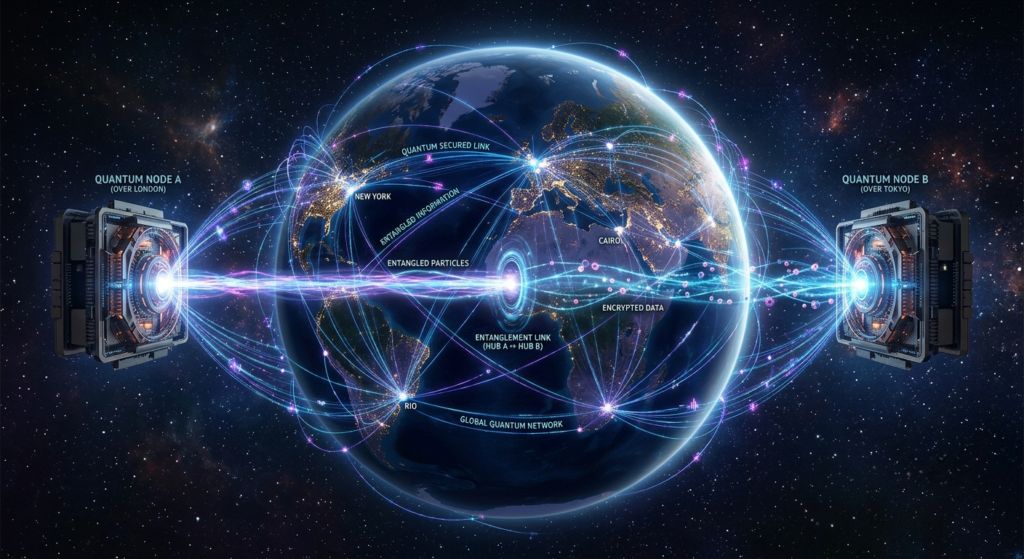
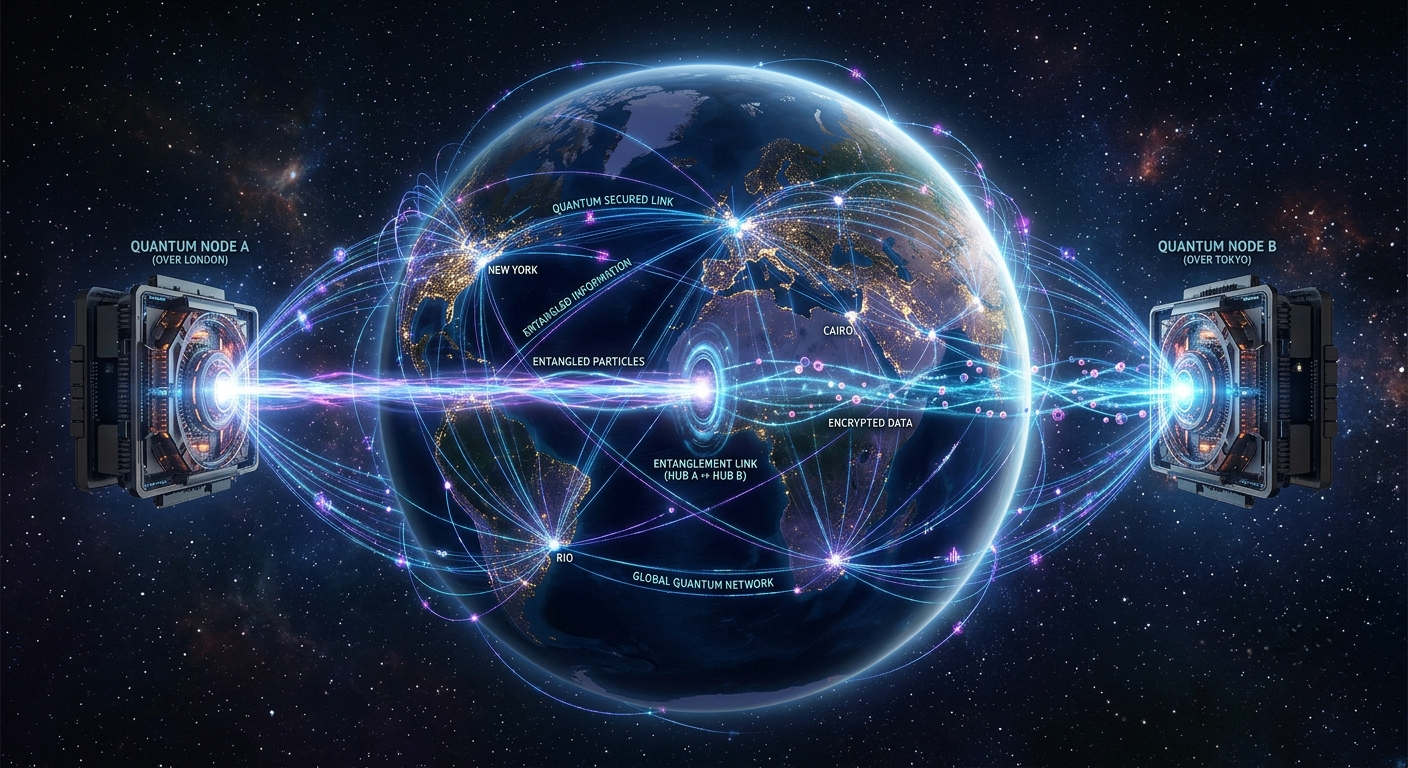
Quantum Internet connecting future communication networks through quantum technology
Quantum Internet could redefine secure communication in the coming decades.

Quantum Internet: 8 Revolutionary Innovations That Could Transform Global Communication

The internet has transformed how people communicate, work, and share information across the globe. Every email, video call, financial transaction, and cloud application depends on digital networks that move enormous amounts of data every second. While today’s internet continues to evolve with technologies like fiber optics, cloud computing, and 6G research, scientists are already working on something far more revolutionary: the Quantum Internet.

Unlike the traditional internet, which transfers information using electrical or optical signals represented as bits (0s and 1s), the Quantum Internet uses the principles of quantum mechanics. Instead of ordinary bits, it relies on qubits, which can exist in multiple states simultaneously and become linked through a phenomenon known as quantum entanglement.

This new networking model has the potential to dramatically improve communication security, enable entirely new computing capabilities, and support scientific discoveries that are impossible with today’s infrastructure.

Although large-scale deployment is still years away, governments, universities, and technology companies worldwide are investing heavily in quantum networking research.

In this article, we’ll explore eight revolutionary innovations that could make the Quantum Internet one of the most important technological breakthroughs of the century.


What Is the Quantum Internet?

The Quantum Internet is a communication network designed to transmit quantum information between quantum devices.

Instead of simply sending digital files, it allows quantum systems to exchange quantum states securely using the laws of physics.

Unlike today’s internet, where data can potentially be intercepted or copied, quantum communication offers fundamentally different security properties.

Key technologies include:

  • quantum entanglement
  • qubits
  • quantum repeaters
  • quantum memory
  • quantum teleportation
  • quantum cryptography

Together, these technologies could create communication systems that are significantly more secure than current networks.


1. Nearly Unbreakable Communication Security

Perhaps the most exciting advantage of the Quantum Internet is its potential to dramatically improve cybersecurity.

Quantum communication uses the laws of quantum physics to detect any attempt to intercept transmitted information.

If someone tries to observe the quantum state during transmission, the information changes immediately, alerting both communicating parties that the connection has been compromised.

This makes undetected eavesdropping far more difficult than on conventional communication networks.

Applications include:

  • government communications
  • military networks
  • financial transactions
  • healthcare records
  • scientific research
  • critical infrastructure

2. Quantum Entanglement Enables New Forms of Communication

Quantum entanglement occurs when two particles become connected in such a way that measuring one immediately influences the state of the other, even when separated by large distances.

This phenomenon forms one of the foundations of quantum networking.

Although entanglement does not allow faster-than-light communication, it enables entirely new methods for securely sharing quantum information that have no equivalent in classical networking.

Researchers continue exploring practical ways to maintain stable entangled connections over increasingly long distances.


3. Quantum Cryptography Strengthens Data Protection

Traditional encryption relies on mathematical problems that are difficult for computers to solve.

Quantum cryptography approaches security differently.

Using techniques such as Quantum Key Distribution (QKD), cryptographic keys can be exchanged with built-in detection of interception attempts.

Benefits include:

  • stronger encryption
  • secure key exchange
  • reduced interception risks
  • enhanced privacy
  • protection for critical systems
  • long-term communication security

As quantum computing advances, quantum cryptography is expected to become increasingly important for protecting sensitive information.


4. Connecting Quantum Computers Worldwide

Future quantum computers may work together through quantum networks.

Instead of operating as isolated machines, multiple quantum computers could exchange quantum information securely and collaborate on solving extremely complex scientific and engineering problems.

Potential applications include:

  • climate modeling
  • pharmaceutical research
  • materials science
  • optimization problems
  • financial modeling
  • artificial intelligence research

Networking quantum computers could dramatically expand their capabilities beyond what individual systems can achieve alone.

5. Quantum Teleportation Could Transform Data Transfer

One of the most fascinating concepts behind the Quantum Internet is quantum teleportation. Despite its science-fiction name, quantum teleportation does not transport physical objects or people. Instead, it transfers the quantum state of one particle to another using quantum entanglement and classical communication.

This process could become an essential building block for future quantum networks by enabling reliable transmission of quantum information over long distances.

Potential applications include:

  • secure quantum networking
  • distributed quantum computing
  • advanced scientific research
  • long-distance quantum communication
  • future satellite networks
  • next-generation cybersecurity

Researchers continue to improve quantum teleportation techniques to make them more practical and scalable for real-world networking.


6. Quantum Repeaters Extend Network Coverage

One of the biggest challenges facing the Quantum Internet is distance.

Quantum signals weaken quickly as they travel through optical fibers, making long-range communication difficult.

Unlike today’s internet, quantum information cannot simply be amplified using traditional signal boosters because measuring quantum data changes its state.

To solve this problem, scientists are developing quantum repeaters.

These specialized devices are designed to:

  • extend communication distances
  • preserve quantum states
  • strengthen network reliability
  • connect multiple quantum nodes
  • improve transmission efficiency
  • support future global quantum networks

Quantum repeaters are expected to become a critical component of large-scale quantum communication infrastructure.


7. Satellite-Based Quantum Communication

Several research organizations are already exploring the use of satellites to build global quantum communication networks.

Instead of relying entirely on underground fiber-optic cables, satellites could distribute quantum encryption keys across continents, helping establish highly secure international communication links.

Potential benefits include:

  • global secure communications
  • intercontinental quantum links
  • improved disaster resilience
  • enhanced government security
  • worldwide research collaboration
  • expanded quantum networking coverage

Combining satellites with terrestrial quantum infrastructure could significantly accelerate the development of worldwide quantum communication systems.


8. The Quantum Internet Could Transform Multiple Industries

The impact of the Quantum Internet may extend far beyond academic research.

Industries that could benefit include:

  • banking and finance
  • healthcare
  • defense
  • telecommunications
  • manufacturing
  • cloud computing
  • scientific research
  • government services

For example, financial institutions could use quantum-secure communication to protect sensitive transactions, while hospitals might exchange confidential medical information with even stronger privacy protections.

As quantum networking technologies mature, entirely new services and applications may emerge that are difficult to imagine using today’s internet.

🔗 Official Resource: https://quantum.ibm.com


Challenges Facing the Quantum Internet

Although the possibilities are exciting, building a global quantum network remains a significant scientific and engineering challenge.

Limited Infrastructure

Current quantum communication networks are largely experimental and operate only across relatively short distances or specialized research environments.

Hardware Complexity

Quantum devices require extremely precise operating conditions, and many systems must function at very low temperatures to maintain stable quantum states.

High Development Costs

Building quantum computers, quantum repeaters, and supporting infrastructure requires substantial investment from governments, universities, and technology companies.

Standardization

Developing common communication standards will be essential to ensure compatibility between future quantum devices, networks, and service providers.

Despite these obstacles, progress continues as research institutions around the world advance quantum networking technologies.


The Future of the Quantum Internet

Although widespread deployment is still likely years away, the Quantum Internet represents one of the most promising frontiers in communication technology.

Future developments may include:

  • global quantum communication networks
  • quantum cloud services
  • distributed quantum computing
  • advanced cybersecurity systems
  • quantum-secure financial transactions
  • ultra-secure government communications
  • AI-assisted quantum network management
  • hybrid classical and quantum internet infrastructure

Rather than replacing today’s internet overnight, quantum networking is expected to complement existing infrastructure by providing new capabilities where extreme security and advanced computing are required.


Final Thoughts

The Quantum Internet has the potential to redefine how information is transmitted, secured, and processed in the decades ahead. By combining quantum entanglement, quantum cryptography, and advanced networking technologies, it could provide levels of security and computational collaboration that are beyond the reach of today’s internet.

While significant technical and infrastructure challenges remain, ongoing research and investment are steadily bringing quantum networking closer to reality. Governments, universities, and technology companies continue to develop the hardware, communication protocols, and security techniques needed to support this next generation of digital connectivity.

Although the Quantum Internet is unlikely to replace the traditional internet anytime soon, it is expected to become a powerful complement for applications requiring exceptional security, scientific collaboration, and distributed quantum computing.

Disclaimer: This article is for informational and educational purposes only. Quantum Internet technologies remain an active area of research, and timelines for widespread deployment are subject to scientific, technical, and commercial developments.